Posts

Gender and the Opportunity Cost of Higher Education

Image
     Going to school everyday was a fairly unstressful experience for me growing up. I never truly struggled in my studies, there was rarely any pressure to meet certain grades, and I always had a way to get to school. I've had it easy. The one thing always purveying my mind throughout the years was the one expectation placed on me by my parents: I was going to go to college, and that was non-negotiable. This was the attitude of the United States in the 2000's after all: educate the youth and leave no child left behind. Even when this cultural attitude to college suddenly flipped in my high school years in response to the shortage of graduates going to trade schools, the measure of success was still codified in my mind. I was going to graduate high school, go get an associate's degree to save money, then transfer and walk across the stage after getting my bachelor's degree from the University of Washington.      About 4 years later, plans obviously changed....

Ability and Social Status - Linguistic Abilities in Morocco

Image
Ability and Social Status - Linguistic Abilities in Morocco One thing that impressed me the most about the Moroccan people I encountered on this study-abroad trip was their ability to speak multiple languages. As a monolingual person, I am both intrigued and envious of bilingual or multilingual persons. I can only imagine what the amalgamation of words spinning around in their heads must be like! In Morocco, I have learned that there are three main languages spoken including Moroccan Arabic, French, and Berber. Our host for the trip, Dr. Richidi, has been a wonderful translator for us throughout this experience and has interpreted many of these languages for us. It was quite surprising to me to see that in so many Moroccan stores and restaurants each of these languages would often be represented in text on signs or menus. However, while it seems that most Moroccans are multilingual, this is not always the case, and sometimes these language skills can be an indicator of social class. Ac...

Gender Roles: Cracking the Glass Ceiling

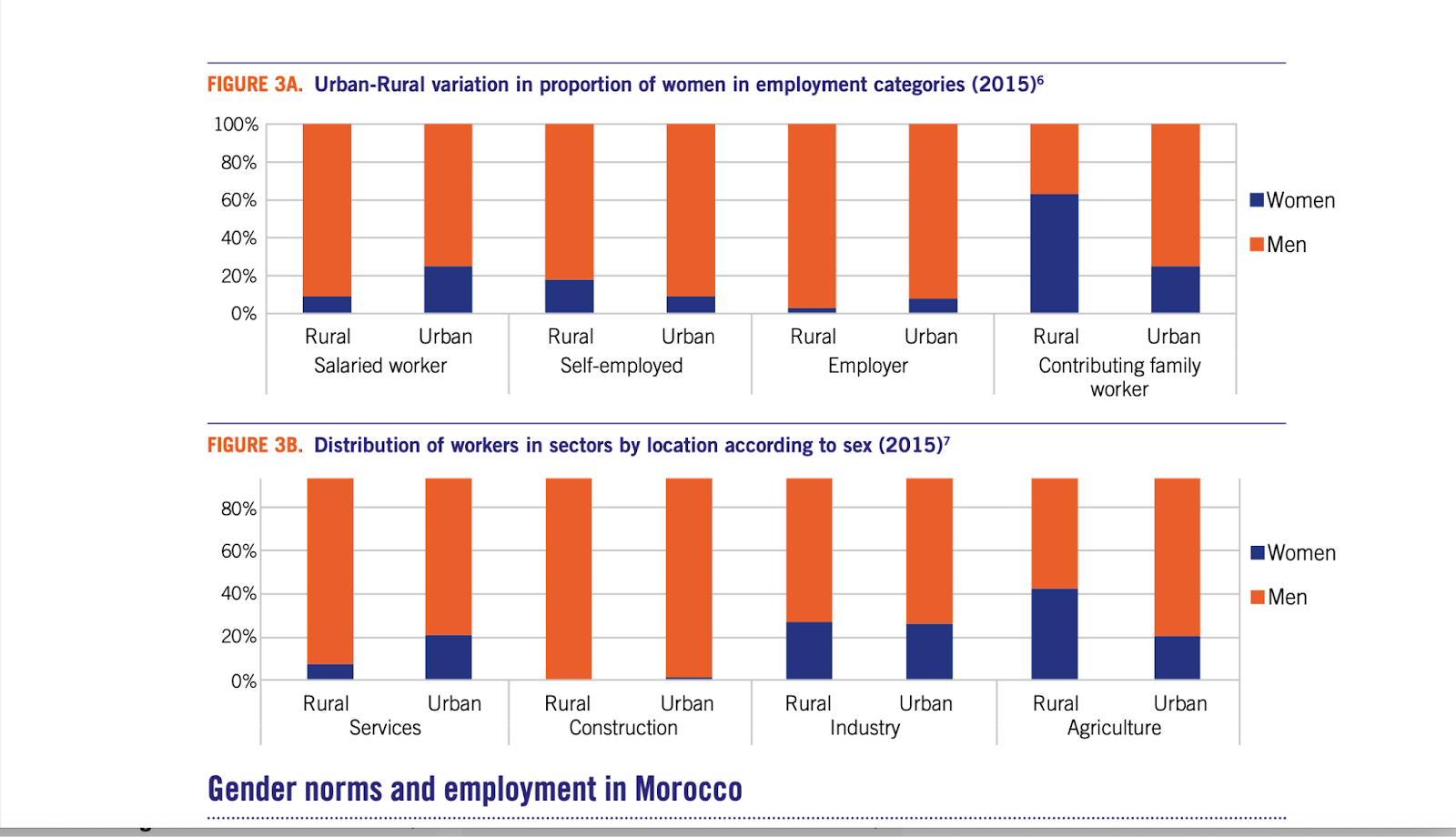
During our recent tours of a few packaging factories in Morocco, I was struck by how deeply rooted gender roles are in the workplace. Most of the factories we visited made it a point to emphasize that specific jobs were designated for men and others for women. This division of labor was evident in how they described the roles women played compared to men. According to the article below, only 21% of the female population in Morocco was in the workforce as of 2019. This comes with a significant rural-urban divide, with only around 17% of women joining the labor force in urban areas. At these packaging factories, I noticed that women were often assigned tasks that required a keen eye for detail, such as selecting products based on specific criteria, which demanded precision and patience. These tasks, while hands-on, were not as physically demanding as the roles assigned to the men, who were given more labor-intensive tasks like heavy lifting and driving motorized forklifts or pallet jac...

Gender Roles

Image
  During my travels in Morocco, I explored the unique gender dynamics shaping Moroccan society, particularly the roles and expectations of women. Traditionally, Moroccan women manage the household and raise children, with strict norms around maintaining virginity and preparing for motherhood, especially in smaller towns and villages. Public interactions between men and women are limited, and women often face restrictions on traveling alone or being out late at night. However, Western influences are gradually changing these norms in cities like Casablanca and Marrakesh, allowing women to take more visible roles in public and professional spheres. I found this evolving role fascinating and encouraging, especially as I observed women in urban areas breaking traditional barriers. Back home on my farm, we only employ men to do all the tasks. Men in Moroccan society traditionally serve as the primary breadwinners and protectors of their families, holding roles in the public sphere such a...

Gender Roles and Sexual Orientation - Sexual Identity in Morocco

Image
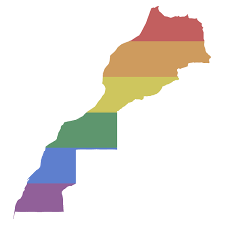
  Blogger Post 2: Gender Roles and Sexual Orientation  My hometown of Brunswick, Georgia recently celebrated its first-ever public Pride Celebration event for the LGTBQ+ community this week while we have been touring in Morocco. I have seen many social media posts from my friends and community members in support of these individuals by attending and participating in the celebration with rainbow flags and colors everywhere and wearing various humorous t-shirts with sayings such as “I like my whiskey straight, but my friends can go either way,” or “Sounds Gay. I’m In!” While there are many Americans who do not support this lifestyle, it is clear that many do and wish to make their support public.  I have not seen any evidence of LGBTQ+ support in Morocco - no rainbow flags anywhere, no t-shirts, and really no mention of sexuality whatsoever. I wondered why this may be the case - why is there apparent silence on this topic when there is so much pride in other places? As a st...

Culture in Cuisine

Image
 Although not in beautiful Morocco with you all, I can sense the importance of culture there from pictures alone. Something that really caught my eye was the food dishes that radiate cultural tradition. The meal I am going to talk about today is named “Djaj Hummar”, a traditional Moroccan Dish composed of roasted chicken, various spices, and olives.  Djah Hummar is cooked using a Tagine, a traditional North African cooking vessel with two pieces that fit together to make a shallow bowl and a tall, conical lid. This cultural pot serves as a slow cooker that can be used in an oven or a stovetop, specifically used for slow-cooked meats. Most Tagine dishes usually have three components: meat, vegetables, and a variety of spices (Rytting, 2022). The cultural significance of the Tagine to traditional Moroccan cuisine is what it symbolizes, hospitality and togetherness.Additioally, it is said that preparation using a Tagine pan allows for more of the aromatics to be tasted in the dis...

Morocco: What a Service-Hearted Home

Image
 I have been lucky enough in life to travel extensively, especially for my age, getting to see so many different cultures in so many different parts of the world. It never ceases to amaze me just how similar we all are. At the core of life, we are all human beings and have the same basic needs and wants. I think it is easy to forget just how similar we all are down to the core, and people allow their difference to divide them instead of to grow together. Morocco, I have learned, is on the same brain wave as I am. They choose everyday to love and appreciate differences in people, as that is what makes each individual their own unique person. They celebrate the differences in a way I have never seen before. Different, but never ever less than.  The unique history of Morocco and the cultures that have landed here have enabled such a hospitable and kind country, the people truly embodying the term service heart. While we have been in Morocco, I have noticed the customs that go alo...