Posts

Race, Ethnicity, Culture or Religion Lucia Gravel

Religion has been a theme of our Morocco trip since our first day at the Hassan II Mosque, yet we’ve barely touched on the specifics of Muslim prayer since then. Some facts: according to the U.S. Department of State, the population of Morocco is estimated at 36.7 million, with over 99 percent identifying as Sunni Muslim. This stands in stark contrast to the 1.34%—or approximately 4.5 million Muslims—in the United States, according to the 2020 U.S. Religion Census. Muslims are expected to pray (salat) five times a day: Fajr (before sunrise), Dhuhr (midday), Asr (afternoon), Maghrib (sunset), and Isha (night). For each prayer, Muslims must be in a state of ritual purity, face the direction of Mecca, pray in a clean place, wear modest and clean clothing, silently intend the specific prayer in their heart, observe the prayer at its designated time, and carry out the proper sequence of physical movements and Qur’an recitations. As we drive through Morocco, I’ve started to notice just h...

Culture in Motion: A Man, a Cart, and the Weight of Tradition

Image
While traveling through Morocco these first few days, I was struck by the diversity of transportation methods; sleek and shiny cars, crowded buses, horse-drawn carriages all used to transport goods and people. Among the hum of engines and hooves, a scene stood out to me as we drove in a rural village to our fruit tour to iberry : a man slowly pushing a wooden cart piled high with colorful rugs.  No horse, no van,...just a man.  At first, it seemed like a simple question of access. Why didn’t he have a car? Or even a horse like others in the area? But those questions quickly pointed to deeper issues…about inequality, mobility, and the weight of preserving tradition. According to the United Nations Development Programme (2020), Morocco has made notable strides in reducing poverty, cutting the rate from 16.2% to under 9% over the past decade. For a country that lacks abundant natural resources, this is a significant achievement (Worldbank, 2018). As we heard from our Casablanca t...

Race, Ethnicity, Culture or Religion - Markeila Howard

Image
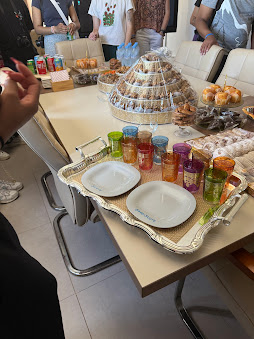
      As I’ve been traveling throughout Morocco, I’ve noticed that many aspects of identity, such as race, ethnicity, culture, and religion, are expressed differently than they are in the United States. Each has its own nuances and traditions. However, the one thing that truly stood out to me during my trip was the generosity and hospitality of Moroccan culture. It left a lasting impression on me within just the first few days.      In my experience back home in the U.S., people can sometimes be more reserved or hesitant to fully welcome someone who looks different or comes from a different background. Of course, that’s not true of everyone, but there is often a subtle emotional or social distance when interacting with those who are seen as “other.” That’s why the warmth I experienced in Morocco felt so heartwarming. It wasn’t just polite; it was genuine, open-hearted, and deeply cultural. From the moment we arrived, people treated ...

Race, Religion, Ethnicity, or Culture - Cooper Hardy

       Religion is always a major part of culture and the identity of a specific group of people. While here in Morocco, I have identified that the religion is Islam is a massive part of the country's identity, being as it is the designated religion of the country. The U.S. Department of State has estimated that of the 37.4 million people in the country, over 99% are Sunni Muslim, and the other 1% consists of groups of Christians, Jews, Shia Muslims, and followers of the Baha’i Faith. (U.S. Department of State, 2024) This naturally means that the minority group of faiths becomes a designated out-group.       However, I have come to understand that the culture of Moroccans is synonymous with hospitality, and despite the religious differences of people, they still make conscious efforts to be inclusive to other religions. This is evident by the archaeology we saw at the Hassan II Mosque on Monday. Our tour guide explained to us that the three large ...

The Culture Regarding Single Moms

Image
               As a soon-to-be mother, I can't imagine raising a baby on my own without the support of my community. It is not lost on me that this is a reality for many. Before my mom met my dad, she was a single mom of two kids. Her life was chaotic, but during this time of single parenting, there were resources readily available for her. Plus, she was within a culture that does not entirely ostracize single mothers. Now, this cannot be generalized. As we have learned in class, one’s core values and beliefs are developed over time and during critical life events. Not all people are accepting of single moms, but overall, in the States, there are resources for single moms and their kids. On our first official tour, Nyem รก emphasized the freedom women have and the progress the King’s wife, Salma Bennani, has made, specifically noting single moms. While researching, I found a dissertation written by Lucilla Valentina Berwick, who completed this...

Animal Welfare Culture in Morocco

Seated around the lunch table today, a woman walked by carrying a cat in a carrier. In the first four days we’ve spent in Morocco, I have seen and interacted with many cats, but this woman was the first evidence of pet ownership I have seen in Morocco. In America, it is common to see families or couples out walking dogs or cats basking in the window’s afternoon sun. Give yourself four days in America, and evidence of pet ownership and the culture of animal care will be abundant. Here, while the animals are abundant, the evidence of animal care and advocacy community work requires a treasure hunt an enthused goodwill shopper would find exhilarating.  This striking difference has both impacted me emotionally and piqued my curiosity surrounding the culture around animal care in Morocco. In Morocco, there are several small organizations focused around the work regarding animal rights, welfare, and animal community management. These organizations rely on volunteers and a small paid staf...