Blog 1 - Race, Ethnicity, Culture or Religion
Before I travelled here to Morocco, I was only vaguely familiar with the Berbers (ie. Amazigh people). On arriving here, I started learning more about them. The Amazigh people are the historically indiginous population, and much of Moroccan culture exists upon the foundations they laid out. The "Arabization" of the country only added an extra layer on top of existing Amazigh cultures and traditions, which is a fact laid out by a handful of our tourguides thusfar as well. Encyclopedia Brittanica highlights that during the spread of Arab cultures (and the Islamic religion), the rise of written Arabic as a script had reduced the Amazigh tongue to a folk language, meaning that it was primarily spread orally (Brett, 2019). In more recent times, one of the Amazigh languages has been revived as a written language called "Tamazight." I've noticed this language and its script on the roadsigns we pass by, or on buildings such as the government buildings with French, Arabic, and now Tamazight script.
Since Morocco's independence, there has been a push for Amazigh culture and language to be recognized formally on a national level. Many tour guides have pointed this out, but successfully in 2011, Morocco officially recognized Tamazight as an official language of the nation alongside Arabic.
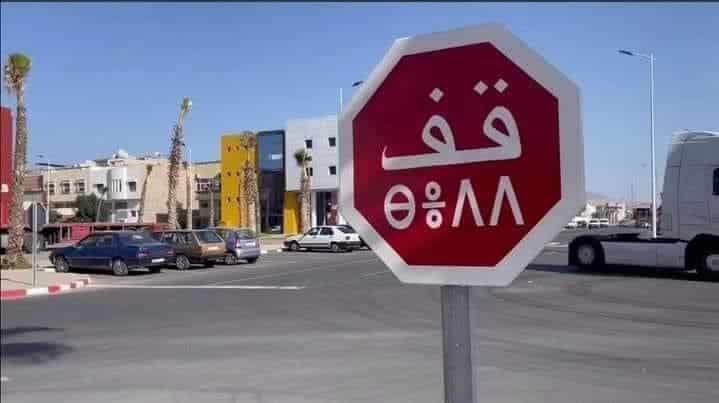
Pictured above is a stop sign in Agadier, Morocco, that uses both Arabic and Tamazight script (Agadier's First, 2026).
I've also noticed that many of these tourguides have continued using the term "Berber", seemingly for our convenience as English-speaking American tourists. Some, such as the one in Chefchaouen and one of the previous ones (I believe in Tanger), as well as the one today in Fes, highlighted that the term "Berber" has derogatory origins. The term "Berber" is derived from words meaning barbarian, which in itself has less than stellar implications, implying these people to be from "backwards" cultures just for being different than their own (Morjani, 2026).
I find it interesting to consider how Amazigh (meaning "free peoples") is the term of choice, and yet some guides of ours have continued using the term Berber, despite highlighting it's derogatory past to us all the same. This wraps back into my thoughts on language here. Many cultures struggle to be recognized in a way that matters, and even to be able to have the language and terminology to be recognized. My own culture, the Bengali culture, and my country's 1971 independence was spurred on by language movements and the need for linguistic freedom as well.
All in all, I think it's interesting to see how the struggle for linguistic freedom can exist across cultures, especially ones that have intertwined as deeply as the Arab culture with the native Amazigh cultures.
Sources Utilized
Agadiers First. (2026). Amazighworldnews.com. https://amazighworldnews.com/agadirs-first-tamazight-stop-sign-a-cultural-milestone-in-morocco/
Ahlam Morjani. (2026, April 7). Who Are The Amazigh People of Morocco? Journey beyond Travel. https://www.journeybeyondtravel.com/blog/morocco-travel-amazigh-berber.html
Brett, M. (2019). Berber | Definition, People, Languages, & Facts | Britannica. In Encyclopædia Britannica. https://www.britannica.com/topic/Berber


Sera, thanks for mentioning the terminology! I've noticed the same thing about the tour guides and have also wondered if it's more for our benefit than anything else. I have run into a similar issue in academic circles. The language family for dialects of Amazigh is called the Berber languages, and so when I have written about them in my classes in the past, I haven't been sure if I should use 'Amazigh' for cultural accuracy, or 'Berber' so its recognized in academic contexts. The idea of linguistic freedom is a really cool one, and not a type of oppression people think about a lot, I think.
ReplyDeleteI really enjoyed reading your blog because I did not know much about the about the history behind the term “Berber” before, and I found it interesting how you connected language to identity and freedom.I really loved how you connected the Amazigh struggle for linguistic recognition to your own Bengali culture and the 1971 independence movement because it showed how language can unite people across very different cultures and experiences.Another thing that I really enjoyed learning about that you mentioned is the revival of Tamazight and its recognition as an official language in 2011 helped me better understand how important language is in preserving culture and history in Morocco. is one thing I found myself while researching more on this topic is that the Moroccan government created the Royal Institute of Amazigh Culture (IRCAM) in 2001 to help keep and promote Amazigh language and traditions through education and media. Which is great because Amazigh culture is the root of Morocco.
ReplyDelete