Posts

Dia de Mortes….more like 40 days

Image
     Dia de mortes, also known as day of the dead, is a day that Latin cultures remember those that have passed.  It is celebrated on November 1.  Families gather for food and celebration.  The Pixar movie CoCo has a great explanation of the meaning behind this day.  As long as your spirit is remembered then you live on but when no one celebrates you, your soul disappears.  This is only one of many ways in which a culture celebrates death and those that have passed.  Each individual, family, community has their own traditions, rituals and beliefs with managing grief in the hopes to get to the space of celebrating a life.  In full honesty, from my perspective, no only truly knows what happens when one dies.  That is the beauty of faith and deep beliefs.       As we have visited locations or with people the concept of death has been apparent to me.  The professor at the first university we visited in Rabat men...

Islamic Exorcisms in Morocco

Image
Islamic Exorcisms in Morocco      In the Islamic faith, it is believed that people, places, or objects can become possessed by "jinn," or spirits. These spirits are believed to be the underlying cause of certain maladies and often serve as an explanation for health, wealth, evil, and ascension to power in society. The spirits can be removed through exorcism, a practice called "ruqya," which is performed by a "raqi," or healer. In a typical exorcism, the possessed person lies down and the raqi places his hand on their forehead whilst reciting verses. The process of exorcism can be divided into three stages:      1. Any and all distractions such as musical instruments, jewelry, pictures in the home, etc. are removed.     2. The raqi then determines if the client is possessed. If there is a spirit present, the raqi then enters           into a conversation with it to determine its nature. After this process, the raqi cle...

Blog 2

Image
 Religion is very different here from what I am used to in the United States. In America, I feel that most people practice their religion at their place of worship or at home and you don't see much of it out in public. Although, that is not the case here in Morocco. As we were in the Silk store in the Medina, I walked to the back of the store where I saw our tour guide on the floor, on a carpet on the ground, praying. I thought this was an amazing sight. The fact that that man and others here in Morocco are willing to be vulnerable and stop what they are doing, even if they are out in public to pray, is pretty amazing. Also, with that willingness to be vulnerable, comes a sense of togetherness. We saw this when we had our blessing dinner. As the music started in the street, I thought it was amazing to see how people were coming out of all the stores and homes to watch. Everyone was smiling and interacting with the music. This shows how this community is willing to be vulnerable and...

Belly dancing in a religious country

Image
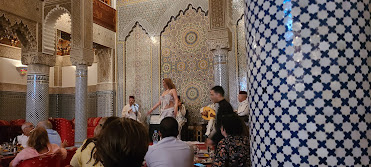
  A significant element of culture is beliefs.   Beliefs are strongly influenced by  religion, a system containing specific practices and perspectives that connect man to a higher being (Beyers, 2017).   There are many religions, but two most prominent ones are Christianity and Islam with both accounting for approximately 55% of the world population that identify as religious (Statista, 2021). Religion manifests itself in behaviors and practices as followers practice instructions of their religion. Religion is so influential that it in-groups and out-groups are formed based on religion (Hannum et al., 2010). In an organization, any differences between members of different religion can be a fault line, an attribute that can split a group, where any conflict can spillover to society at large ( Hannum et al., 2010 ) Religion has been discussed from the very start of our trip, at orientations and in materials that were accessed in preparation for coming to Morocco. Durin...

Blog 2: Religion or Belief Systems

Image
     Being in a predominantly Muslim part of the world when we come from a predominantly Christian country, it is not hard to recognize these as differing identities. A particular aspect of our tour in Medina that piqued my interest was the cleaning ritual (Wudhu or Wudu) that Muslims partake in before praying. To quote our wonderful guide for the day with additional requirements from BBC (2022), the process of this washing is as follows:  Right then left hand three times Mouth three times Breathe water in through the nose softly three times Wash face at least once, but usually, this is done three times Right arm up to the elbow three times Left arm up to the elbow three times Water from wet hands goes through the hair from the hairline to over the head Wipe the back and inside of ears Right foot up to the ankles three times Left foot up to the ankles three times      This ritual is done in order to prepare for an "appointment before God" as described ...

Blogger 2: Religion and Personal Beliefs

Image
  Moroccan religious or celebratory music revolves around either the cleansing of the spirit, the celebration of a union, or for purely enjoyment purposes (Schuyler, 1981). One genre is called Gnawa and is known for being a traditional form of Islamic religious songs and rhythms founded in Morocco and West Africa. Unlike many of the songs heard in more tradition Catholic or conservative churches in the Western culture, the music is made to invoke rhythmic movements from the listener (Schuyler, 1981). Dancing is a major part of the culture surrounding Gnawa and other religious/celebratory music and the game of Txabia (a musical game of hide-and-seek) is an excellent example of how that music is used (Schuyler, 1981). After proper ceremonies, Txabia is used as a part of the ritual devoted to enjoyment after more serious moments where dancers are entranced (Schuyler, 1981). The musical ceremony we saw yesterday also encouraged free dancing and movement that was intertwined with both r...

Blog Post #2: Religion in Morocco

 I have read multiple articles on religion in Morocco, and it is clear that Sunni Muslim is the dominant religion in Morocco. According to this International Religious Freedom Report for 2019, more than 99% of the population in Morocco is Sunni Muslim ( U.S. Department of State,  2020). Even more interesting is that Casablanca was named the place with the highest religious diversity multiple times. Compared to the United States, this is very isolated diversity. I grew up in the southeast part of the United States, where Christianity is the dominant religion. However, I was often exposed to other religions; even in my household, one of my parents was Christian while the other was Muslim. I never felt pressured to choose a religion or act religious at all, but my parents allowed me to explore all religions. The freedom of religion expressed in the US is often without the pressures of society. It is common to have people in the same community who openly practice different religio...